When a property insurance claim becomes confusing, slow, or far more complicated than expected, one question usually rises to the surface: are public adjusters worth it? The answer is not always a simple yes or no. In many cases, the value of hiring one depends on the size of the loss, the quality of the insurer’s estimate, the time required to manage the claim, and the fee charged for professional representation.
A small, straightforward claim may not need outside help.
A large fire, water, hail, or commercial property claim can be a very different story.
Insurance claims often look manageable at the beginning. You report the damage, schedule an inspection, receive an estimate, and wait for payment. At least, that is how the process appears on paper. In reality, a serious claim may involve multiple inspections, contractor estimates, repair pricing disputes, personal property inventories, policy questions, deadlines, depreciation, and repeated requests for documentation.
That is where a public adjuster may become valuable.
Before signing a contract, however, property owners should understand exactly what a public adjuster does, what the service may cost, and how to measure whether the potential benefit justifies the expense.
What Is a Public Adjuster?
A public adjuster is a licensed professional who represents the policyholder during a property insurance claim.
That distinction matters.
An insurance company adjuster works for the insurance carrier. An independent adjuster may be hired by the carrier to inspect and evaluate the damage. A public adjuster, by contrast, is hired by the homeowner, business owner, landlord, or other insured party.
The public adjuster’s job is generally to help document the loss, prepare an estimate, organize supporting evidence, communicate with the carrier, and negotiate the amount of the covered claim.
A public adjuster does not control the insurance company’s final decision. The adjuster also cannot create coverage that does not exist in the policy.
Still, good documentation can have a major effect on how a claim is evaluated.
Many property owners assume the insurance company will automatically identify every damaged item, calculate every necessary repair, and include all related costs in the first estimate. Sometimes that happens. Sometimes it does not.
The first inspection may be brief. Hidden or less obvious damage may not be included. Certain labor steps, materials, permits, access costs, or related repairs may be missing from the scope.
A public adjuster looks at the claim from the policyholder’s side.
What Does a Public Adjuster Actually Do?
The exact services depend on the company and the contract, but the work may include:
- Inspecting the damaged property
- Reviewing the insurance policy
- Photographing and measuring affected areas
- Identifying damaged building materials
- Preparing repair or replacement estimates
- Organizing receipts, invoices, reports, and inventories
- Reviewing the insurer’s estimate for missing items
- Communicating with insurance representatives
- Preparing proof-of-loss documents
- Tracking requests and claim deadlines
- Negotiating disputed repair costs or scope items
That is a substantial workload.
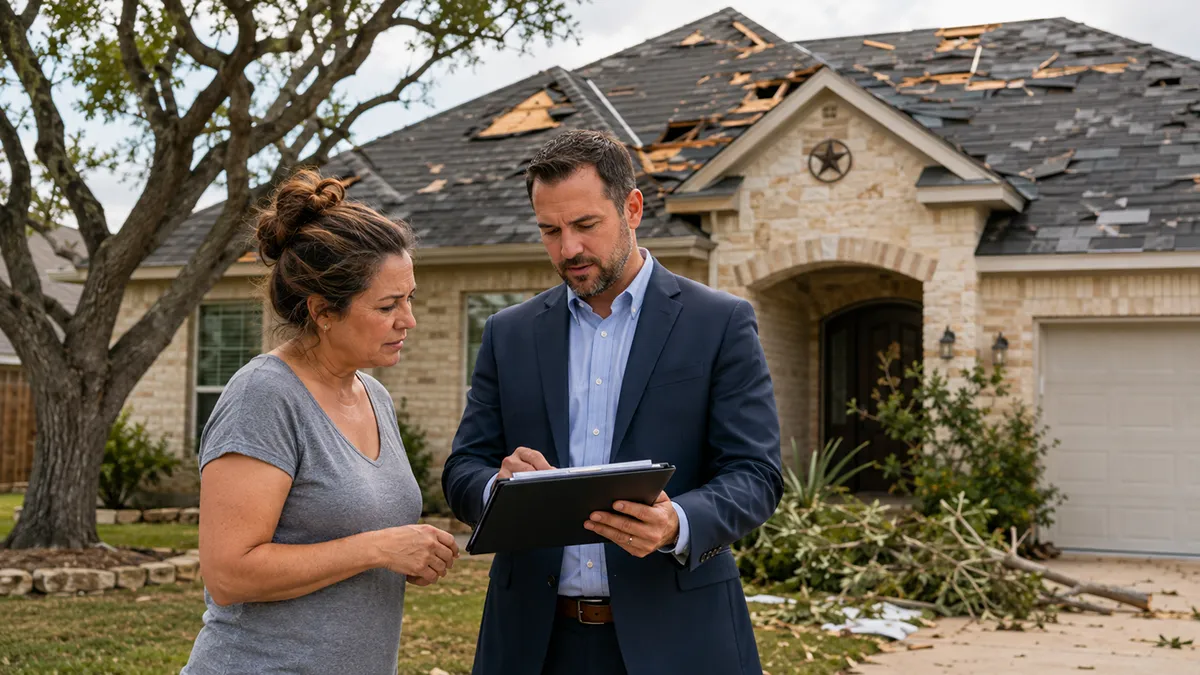
Consider a house with hail damage. The visible issue may be the roof, but the complete loss could also involve gutters, vents, flashing, window screens, fencing, exterior paint, siding, garage doors, interior leaks, insulation, and damaged ceilings.
Every item must be observed, documented, priced, and tied to the reported event.
If the policyholder overlooks part of the loss during the claim process, recovering those costs later may become more difficult.
Why Property Owners Hire Public Adjusters
People rarely hire a public adjuster because they want another person involved in the process. They hire one because the claim has become difficult to manage.
Common reasons include:
- The insurance estimate appears too low
- The damage is extensive
- Important repairs were omitted
- The claim requires a detailed personal property inventory
- The policyholder has limited time
- The insurer repeatedly requests additional documents
- The claim has stalled
- The property owner does not understand the estimate
- Several contractors disagree with the insurer’s pricing
- The damage affects a business or rental property
Managing a significant claim can feel like a second job.
There may be phone calls during work hours. Contractors need access. Documents must be uploaded. Estimates require review. Inspections get rescheduled. New damage may be discovered once repairs begin.
A public adjuster can take over much of that administrative and technical work.
That convenience has value, even when the final settlement increase is not dramatic.
Are Public Adjusters Worth It for Large Claims?
For many large property claims, the answer may be yes.
Large losses create more opportunities for missed damage, pricing disagreements, documentation problems, and delays. They also involve more money, which means even a modest difference in the claim estimate can have a meaningful impact.
Suppose a severe storm damages a large home.
The insurer’s initial estimate may include roof replacement and several exterior repairs. A more detailed inspection may reveal additional damage to gutters, vents, fencing, interior finishes, insulation, and electrical components affected by water intrusion.
If those items are covered but missing from the original estimate, the difference could be substantial.
Public adjusters may be particularly useful for claims involving:
- Major fires
- Extensive water damage
- Large hail losses
- Tornado or wind damage
- Commercial buildings
- Apartment or rental properties
- Multiple structures
- Business equipment
- Large personal property inventories
- Complicated repair scopes
The larger the claim, the more important accurate documentation becomes.
Still, size alone does not settle the question. A large claim that is already thoroughly documented and fairly estimated may not require additional representation. The policyholder should compare the expected benefit with the fee.
Are Public Adjusters Worth It for Small Claims?
Not always.
A minor claim may be easy to inspect, estimate, and resolve without professional representation. Hiring a public adjuster for a small loss could reduce the net payment available for repairs, especially if the adjuster charges a minimum fee or a percentage of the recovery.
Imagine a limited plumbing leak affecting a small section of drywall and flooring. The insurance carrier responds quickly, the estimate matches contractor pricing, and payment is issued without a dispute.
In that situation, a public adjuster may add little financial value.
Small claims are generally easier to handle when:
- The cause of damage is clear
- The affected area is limited
- The insurance estimate is detailed
- Local contractors agree with the pricing
- Communication with the insurer is consistent
- The policyholder has time to manage the process
- There are no major disagreements about the repair scope
This does not mean small claims never need help.
A relatively small loss can still become complicated when the cause is disputed, repairs require matching materials, or the insurer excludes important work. The real issue is not just the dollar amount. It is the difference between what the claim requires and what the insurance company has included.
The Main Benefits of Hiring a Public Adjuster
More Thorough Damage Documentation
Documentation is the foundation of a property claim.
Photographs help, but photographs alone may not explain the full cost of repair. Measurements, material descriptions, room-by-room scopes, contractor estimates, inventory lists, and supporting reports may also be needed.
A public adjuster can organize this information into a structured claim presentation.
That matters because vague statements rarely move a claim forward.
Saying “the kitchen is badly damaged” is less useful than identifying the exact cabinets, flooring, drywall, insulation, electrical work, trim, paint, appliance connections, demolition, disposal, and installation work required.
Specific evidence produces clearer conversations.
A More Detailed Estimate
Insurance estimates are often long, but length does not guarantee completeness.
A repair estimate may omit:
- Debris removal
- Material delivery
- Detaching and resetting fixtures
- Access work
- Matching adjacent finishes
- Permit costs
- Code-related upgrades when covered
- Contractor overhead
- Specialty labor
- Temporary protection
- Cleaning
- Storage or moving costs
Some missing items may be small. Together, they can become significant.
A public adjuster may compare the insurer’s estimate with the actual repair process and identify gaps that deserve further review.
Less Stress and Less Administrative Work
Claims create paperwork.
Lots of it.
A policyholder may need to track emails, inspection dates, estimates, receipts, temporary repair costs, hotel expenses, damaged inventory, mortgage company requirements, and contractor questions.
The burden grows quickly after a major loss.
Hiring a public adjuster can allow the property owner to focus on safety, temporary housing, business operations, repairs, and family responsibilities while someone else manages the claim documentation.
That practical benefit should not be ignored when deciding are public adjusters worth it.
Help With Claim Negotiations
Insurance claim disagreements are often about details rather than dramatic disputes.
The insurer may agree that the roof is damaged but disagree about the number of damaged slopes. It may approve drywall replacement but not insulation. It may allow for a basic material when the existing property contains a more expensive product.
A public adjuster can present evidence supporting the policyholder’s position.
This does not guarantee agreement.
It does, however, create a more organized and informed negotiation.
Potential Drawbacks of Hiring a Public Adjuster
Public adjusters are not the right answer for every claim.
There are real costs and limitations.
The Fee Reduces the Net Recovery
Public adjusters charge for their services. The fee arrangement should be clearly explained in the contract before any work begins.
Depending on the agreement, the adjuster may charge a percentage of the insurance recovery, a flat fee, an hourly amount, or another approved structure.
The property owner must look beyond the total settlement.
What matters is the net result after the fee.
A larger insurance payment may sound impressive, but the policyholder should calculate how much remains for repairs after all professional costs are deducted.
Results Are Not Guaranteed
No responsible public adjuster should guarantee a specific settlement amount.
Claim outcomes depend on the policy language, cause of damage, available evidence, exclusions, deductibles, limits, repair pricing, prior damage, and the insurer’s evaluation.
A public adjuster can improve documentation and advocate for a different estimate.
That is not the same as guaranteeing payment.
Quality Varies
Experience, communication, estimating ability, and attention to detail can vary from one adjuster to another.
Some public adjusters are highly involved. Others may delegate most of the work. Some provide frequent updates. Others may be difficult to reach.
That is why the interview process matters.
The property owner should know who will inspect the building, who will prepare the estimate, who will communicate with the insurer, and who will answer questions during the claim.
The Process May Take Longer
A detailed claim review can require time.
Additional inspections may be scheduled. Estimates may need to be revised. Contractors or specialists may need to provide reports. The insurance company may review new documentation before responding.
This can extend the timeline.
For a major or underpaid claim, additional time may be worthwhile. For a simple claim that is moving smoothly, extra steps may be unnecessary.
How Much Does a Public Adjuster Cost?
The fee should never be a surprise.
Before signing an agreement, ask for a written explanation of:
- How the fee is calculated
- Which insurance payments are included
- Whether the fee applies to money already offered
- Whether there is a minimum charge
- When payment becomes due
- Which services are included
- Whether outside experts cost extra
- How the agreement may be canceled
- What happens if no additional payment is obtained
Read every section.
Do not rely only on a verbal explanation.
A useful way to evaluate the fee is to calculate several possible outcomes before hiring the adjuster.
| Scenario | Insurance Payment | Adjuster Fee | Net to Policyholder |
|---|---|---|---|
| Current insurer estimate | $40,000 | $0 | $40,000 |
| Revised claim estimate | $55,000 | Example fee of $5,500 | $49,500 |
| Revised claim estimate | $45,000 | Example fee of $4,500 | $40,500 |
These figures are only examples.
The first revised scenario creates a clear net increase. The second creates only a small difference after the fee. That may still be worthwhile if the adjuster saves substantial time or helps resolve major repair issues, but the financial benefit is less obvious.
Run the numbers.
When a Public Adjuster May Be Worth It
A public adjuster may provide strong value when:
- The loss is large
- The damage affects several rooms or systems
- The insurer’s estimate appears incomplete
- Contractors identify missing work
- The claim includes a large personal property inventory
- The building is commercial or income-producing
- The policyholder cannot manage the paperwork
- Communication with the insurer has become difficult
- Multiple inspections are required
- The repair scope is disputed
- The claim has stalled
- The insurer’s estimate is far below realistic repair pricing
In these situations, asking are public adjusters worth it becomes less about whether help is useful and more about whether the expected improvement justifies the fee.
When You May Not Need a Public Adjuster
You may be able to handle the claim yourself when:
- The damage is minor
- The insurance company responds promptly
- The estimate is accurate and detailed
- Contractors agree with the allowed scope
- The payment covers reasonable repair costs
- The documentation requirements are simple
- You have enough time to manage the process
- There is no significant disagreement
It is also important to recognize when the issue may require a different professional.
A public adjuster handles claim preparation and settlement negotiations. A coverage dispute, lawsuit, accusation of bad faith, or complicated legal question may require an attorney.
The two roles are not interchangeable.
Questions to Ask Before Hiring a Public Adjuster
A strong interview can prevent problems later.
Ask:
- Are you licensed to work in Texas?
- How many claims like mine have you handled?
- Who will personally manage my claim?
- How will you calculate your fee?
- Does the fee apply to payments already offered?
- What services are included?
- Will I pay for outside experts?
- How often will you update me?
- What documents will you need?
- Can you provide recent references?
- What happens if the insurer does not increase the payment?
- How can I cancel the agreement?
- Have you handled claims in Belton or Central Texas?
- Will I receive copies of all estimates and communications?
Listen closely to the answers.
Clear professionals explain the process without creating pressure.
Red Flags to Watch For
Some warning signs should stop the conversation immediately.
Be cautious when someone:
- Guarantees a specific settlement
- Pressures you to sign on the spot
- Refuses to explain the fee
- Asks you to sign blank forms
- Cannot verify licensing
- Encourages exaggeration
- Promises every damaged item will be covered
- Avoids questions about the contract
- Will not provide copies of documents
- Is difficult to reach before the agreement is signed
A professional representative should make the process clearer, not more confusing.
Public Adjuster vs. Attorney
Property owners sometimes assume a public adjuster and an insurance attorney perform the same work.
They do not.
A public adjuster generally focuses on the value and documentation of the loss. This may include inspections, estimates, inventories, policy review, claim presentation, and settlement discussions.
An attorney focuses on legal rights and legal disputes.
You may need an attorney when:
- The claim is denied based on a legal interpretation
- A lawsuit may be necessary
- The insurer is accused of improper conduct
- The dispute concerns legal deadlines
- Examination under oath issues arise
- The claim involves complex liability or coverage questions
Some claims begin as estimating disputes and later become legal disputes.
Choose the professional based on the actual problem.
Why Local Experience Matters in Belton
Belton and the surrounding Central Texas area can experience hail, strong winds, plumbing failures, fires, roof leaks, and severe storms.
Local construction conditions matter.
Roofing materials, labor pricing, permitting requirements, contractor availability, and regional building practices may affect the realistic cost of repairing a property.
A public adjuster familiar with the area may also understand common storm patterns and the types of damage frequently found in local homes and commercial buildings.
That local familiarity does not guarantee a particular outcome.
It can, however, improve the accuracy of inspections and estimates.
Belton Public Adjuster works with property owners who need help understanding, documenting, and presenting residential or commercial insurance claims. The goal should always be straightforward: identify the covered damage, prepare clear evidence, and help the policyholder make an informed decision.
A Simple Decision Framework
Still asking are public adjusters worth it?
Use this process.
Step 1: Measure the Size of the Loss
List every affected room, structure, system, and personal property category.
Do not focus only on the most obvious damage.
Step 2: Review the Insurer’s Estimate
Compare the estimate with the actual work contractors say is required.
Look for missing rooms, materials, labor steps, quantities, and related repairs.
Step 3: Get Independent Repair Information
Request written estimates from qualified contractors.
Ask them to explain major differences rather than simply providing a higher number.
Step 4: Calculate the Potential Fee
Estimate what the public adjuster may earn under several settlement outcomes.
Focus on your net recovery.
Step 5: Consider Your Time
Be honest.
Can you manage repeated calls, inspections, estimates, receipts, and document requests without missing important details?
Step 6: Interview More Than One Adjuster
Compare experience, communication, fees, contract terms, and claim strategy.
Do not choose based only on promises.
Step 7: Decide What Problem You Need Solved
Do you need better documentation? A detailed estimate? Negotiation help? Legal advice? Faster communication?
Hire the professional whose role matches the problem.
So, Are Public Adjusters Worth It?
For large, complicated, underdocumented, or disputed property claims, public adjusters can be worth the cost.
They may uncover missing damage, prepare a more complete estimate, organize claim evidence, reduce the policyholder’s workload, and negotiate disputed items with the insurance company.
For small claims, the answer may be different.
When the insurer’s estimate is accurate, communication is smooth, and the payment reasonably covers repairs, hiring a public adjuster may not provide enough additional value to justify the fee.
The best decision is based on numbers, not emotion.
Compare the current insurance estimate with realistic repair costs. Review the proposed fee. Consider the complexity of the claim and the amount of time required to manage it. Then decide whether professional representation is likely to produce a stronger net result.
So, are public adjusters worth it?
Sometimes, absolutely.
But the value depends on the claim, the contract, and the quality of the person you hire. Review all three carefully before moving forward.
FAQs
1. Are public adjusters worth it for large insurance claims?
Public adjusters may be worth the fee when a claim involves extensive damage, complicated documentation, or a major difference between repair costs and the insurer’s estimate.
2. How much does a public adjuster charge?
Public adjusters may charge a percentage of the insurance recovery, a flat fee, or another agreed amount. Always review the fee structure and payment terms before signing a contract.
3. Can a public adjuster increase an insurance settlement?
A public adjuster may identify missing damage, prepare a more detailed estimate, and support requests for additional payment. However, no adjuster can guarantee that the insurer will increase the settlement.
4. When should I hire a public adjuster?
Consider hiring one when the claim is large, the insurer’s estimate seems incomplete, or you lack the time and experience to manage the documentation and negotiations.
5. Are public adjusters worth it for roof claims?
They can be valuable when roof damage extends beyond shingles or when the insurer and contractor disagree about the required repairs. Small, clearly documented roof claims may not require representation.
6. Can I hire a public adjuster after receiving an insurance estimate?
Yes, property owners can often hire a public adjuster after reviewing the insurer’s estimate. The adjuster may examine the existing scope and identify covered items that were overlooked or undervalued.
7. Do public adjusters work for insurance companies?
No. Public adjusters represent policyholders, while staff and independent insurance adjusters generally work for or on behalf of the insurance company.
8. Can a public adjuster help with a denied claim?
A public adjuster may help gather documentation and determine whether damage was properly presented. Legal coverage disputes or formal denials may require advice from an insurance attorney.
9. How do I choose a public adjuster in Texas?
Verify the adjuster’s license, experience, fee terms, communication process, references, and familiarity with your type of property damage. Avoid anyone who guarantees a specific payment.
10. Is a public adjuster necessary for every property claim?
No. Minor claims with accurate estimates, responsive communication, and sufficient repair payments can often be handled directly by the policyholder.